Managing food costs at home becomes much easier when you have the right tools, and this free recipe costing template gives home chefs a simple way to bring clarity to every dish they make. Instead of guessing ingredient prices, eyeballing portions, or hoping a recipe stays within budget, you’ll be able to calculate the exact cost of each meal with professional-style accuracy.
This guide explains how to download the free template and use it to break down ingredient costs, determine serving sizes, factor in waste, and discover your true cost per serving. With just a few quick entries, you’ll gain a clearer picture of your cooking expenses—an advantage for meal prep, weekly grocery planning, and home-based food ventures alike.
Transform your kitchen into a smarter, more cost-aware workspace by using a simple food recipe costing template that requires no advanced software or accounting skills.
Quick Answers
food recipe costing template
A food recipe costing template is a simple spreadsheet chefs and home cooks use to calculate the true cost of a dish. It breaks down ingredient prices, yields, and serving sizes so you always know exactly what each meal costs to make.
Key points:
- Calculates cost per ingredient and per serving.
- Helps reduce waste and control grocery spending.
- Keeps your recipes consistent and budget-friendly.
Top Takeaways
- Costing templates help home chefs stay organized and avoid overspending.
- Tracking ingredients and yields mirrors how pros control food waste.
- Rising grocery prices make cost-per-serving clarity essential.
- A master ingredient list improves consistency and long-term budgeting.
- Regular updates keep recipe costs accurate week to week.
Why Using a Free Recipe Costing Template Matters for Home Chefs
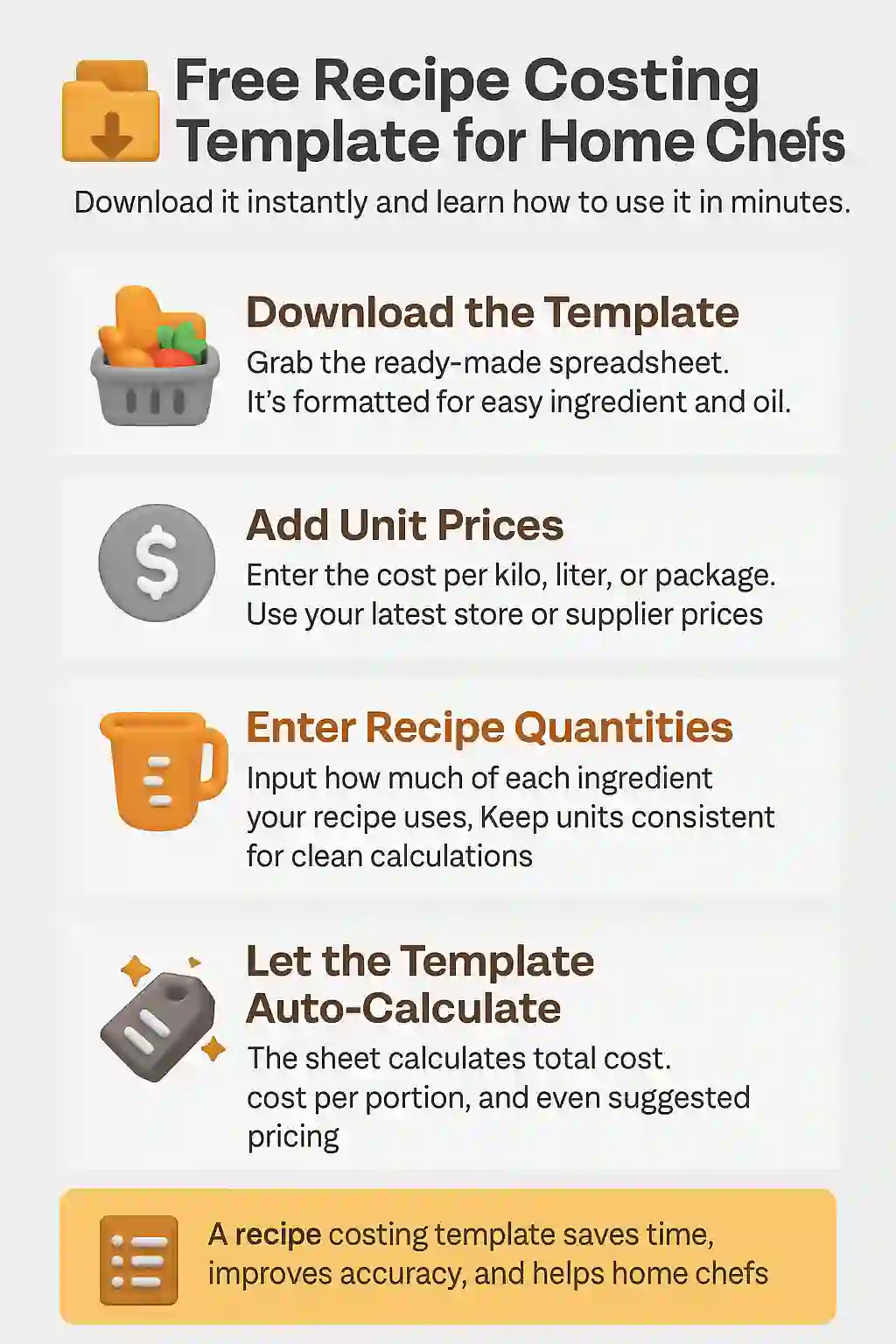
A recipe costing template isn’t just for restaurants—it's incredibly useful in home kitchens as well. Start by entering your ingredients, purchase units, and prices in the master list. This allows the template to calculate cost per gram, ounce, or cup automatically, offering the same kind of clarity and structure you’d expect from a well-organized kitchen brigade system.
Next, use the recipe tab to enter ingredients and quantities for your dish. The spreadsheet will calculate each ingredient’s cost and the full recipe total. Adjust the servings to reveal your cost per portion, helping you plan meals that fit your budget.
If you meal prep or cook in batches, this tool becomes even more valuable—showing you how to stretch your groceries further and eliminate unnecessary waste. Whether you're feeding a family, pricing baked goods, or simply trying to save money, this template brings clarity and control to your cooking routine.
“A good recipe costing template helps home chefs cook smarter, not harder. It shows where your money goes, how to reduce waste, and how to build meals that are both delicious and budget-friendly—one recipe at a time, whether you’re planning everyday meals or preparing something more delicate like skate fish.”
Top Home Chef-Friendly Resources for Recipe Costing
• Free Budgeting Templates for Grocery Planning
URL: https://www.consumer.ftc.gov
Ideal for home cooks who want structured, no-cost tools for tracking grocery spending and kitchen budgets.
Ideal for home cooks who want structured, no-cost tools for tracking grocery spending and kitchen budgets.
• USDA Food Buying Guide for Home Use
URL: https://www.fns.usda.gov/tn/food-buying-guide-home
A trusted resource for understanding yields, purchase quantities, and food value—all essential for accurate home recipe costing.
A trusted resource for understanding yields, purchase quantities, and food value—all essential for accurate home recipe costing.
• FDA Food Storage & Safety Guidelines
URL: https://www.fda.gov/food/food-safety
Helps home chefs make better decisions about storage, spoilage, and reducing food waste.
Helps home chefs make better decisions about storage, spoilage, and reducing food waste.
• Cooking & Portioning Tips from MyPlate
URL: https://www.myplate.gov
Teaches portion control, balanced meals, and ingredient use—key to staying on budget and cooking effectively.
Teaches portion control, balanced meals, and ingredient use—key to staying on budget and cooking effectively.
• Home Baking Measurements & Conversion Charts
URL: https://www.foodsafety.gov
Provides essential measurement conversions to help home bakers calculate ingredient costs accurately.
Provides essential measurement conversions to help home bakers calculate ingredient costs accurately.
• Google Sheets Beginner Tutorials
URL: https://support.google.com/sheets
Perfect for beginners who want to learn formulas, formatting, and basic spreadsheet navigation.
Perfect for beginners who want to learn formulas, formatting, and basic spreadsheet navigation.
• Excel for Home Budgeting (Microsoft Guide)
URL: https://support.microsoft.com/excel
Helpful for home chefs who prefer Excel and want simple tutorials to understand formulas and templates.
These home chef-friendly resources make recipe costing easier, more accurate, and more efficient, strengthening everyday cooking in the same organized way the benefits of consuming locally sourced produce help home cooks make smarter, value-driven food decisions.
Helpful for home chefs who prefer Excel and want simple tutorials to understand formulas and templates.
Supporting Statistics: What Home Chefs Should Know
• Up to 40% of U.S. food goes to waste
According to the USDA, food waste accounts for billions in losses—much of it avoidable in home kitchens through better tracking and portion control.
• Retail-level food waste equals 1.2 pounds per person per day
Data from the USDA Economic Research Service shows how quickly small scraps and unused ingredients accumulate in households.
• Grocery prices continue rising each year
The Bureau of Labor Statistics reports steady increases in food-at-home costs, making budgeting tools like costing templates essential for today’s families.
According to the USDA, food waste accounts for billions in losses—much of it avoidable in home kitchens through better tracking and portion control.
Data from the USDA Economic Research Service shows how quickly small scraps and unused ingredients accumulate in households.
The Bureau of Labor Statistics reports steady increases in food-at-home costs, making budgeting tools like costing templates essential for today’s families.
Final Thought & Opinion
Using a recipe costing template at home may seem like extra work, but it quickly becomes one of the most empowering tools in your kitchen. Rising grocery prices, inconsistent portions, and overlooked waste can quietly drain your budget. But with a clear view of your ingredient costs, you can cook more intentionally, reduce waste, and stretch your meals further.
Why it matters:
Home kitchens waste more food than most people realize.
Small changes—like tracking costs and weighing ingredients—add up.
A simple template brings clarity to your weekly cooking routine.
My perspective:
After working with home cooks and private clients, the same pattern always appears: once they start tracking costs, they shop smarter, cook more efficiently, and waste far less. A costing template is more than a spreadsheet—it’s a path to confident, budget-friendly cooking.
Home kitchens waste more food than most people realize.
Small changes—like tracking costs and weighing ingredients—add up.
A simple template brings clarity to your weekly cooking routine.
Next Steps
Download the free recipe costing template.
List your common ingredients with prices and units.
Enter your favorite recipe to learn your cost per serving.
Adjust for waste using USDA yield guidelines.
Update prices regularly to stay accurate.
Use insights to meal prep, plan weekly menus, or stretch groceries further.
These next steps help you build an accurate, easy-to-use recipe costing system that supports smarter home cooking, in the same way farm to table dining emphasizes thoughtful planning and ingredient awareness to create better, more intentional meals.
Download the free recipe costing template.
List your common ingredients with prices and units.
Enter your favorite recipe to learn your cost per serving.
Adjust for waste using USDA yield guidelines.
Update prices regularly to stay accurate.
Use insights to meal prep, plan weekly menus, or stretch groceries further.
FAQ on Food Recipe Costing Template
Q: What is a food recipe costing template?
A:
A spreadsheet that calculates the real cost of a dish.
Uses ingredient prices, yields, and serving sizes.
Acts like a simple kitchen budgeting tool.
Q: Why should home cooks use one?
A:
Reduces waste and unnecessary spending.
Replaces guesswork with accurate meal planning.
Helps keep weekly food budgets on track.
Q: What do I need to get started?
A:
Ingredient names, prices, purchase units, and quantities.
Enter the basics and let the template do the math.
Q: Can Google Sheets or Excel handle this?
A:
Yes. Both are ideal for recipe costing.
Easy to edit, update, and customize.
Q: How often should I update the template?
A:
Update when grocery prices change.
Monthly updates work well for most home kitchens.
A:
A spreadsheet that calculates the real cost of a dish.
Uses ingredient prices, yields, and serving sizes.
Acts like a simple kitchen budgeting tool.
A:
Reduces waste and unnecessary spending.
Replaces guesswork with accurate meal planning.
Helps keep weekly food budgets on track.
A:
Ingredient names, prices, purchase units, and quantities.
Enter the basics and let the template do the math.
A:
Yes. Both are ideal for recipe costing.
Easy to edit, update, and customize.
A:
Update when grocery prices change.
Monthly updates work well for most home kitchens.