That's the problem with shopping for environmentally friendly soap for camping by trusting the front of the bottle. The real information sits on the back. Eco-friendly camping soap is a category where the marketing and the chemistry frequently disagree, and the gap matters because the choice you make on the shelf determines what happens to the next stream you wash near. Here's what to look for before you pack one.
TL;DR Quick Answers
environmentally friendly soap for camping
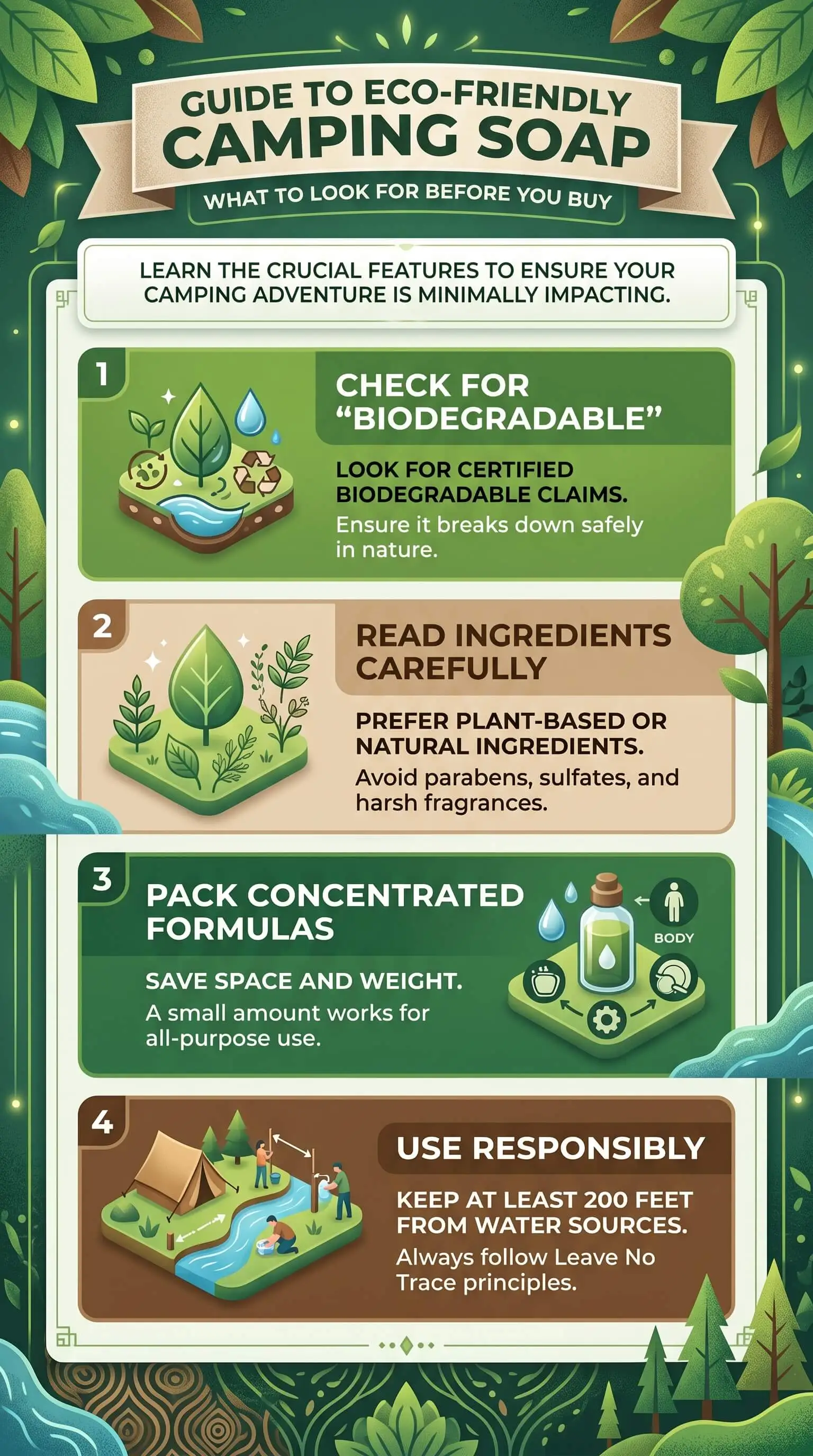
Most "eco-friendly" camping soaps fail on one of three things: synthetic ingredients they don't disclose, a biodegradability claim that only works in soil, or plastic packaging that cancels the formulation. The ones worth buying get all three right.
Look for a concentrated castile or certified bar with a short, readable ingredient list. Credible certifications include EPA Safer Choice, USDA Organic, NSF/ANSI 305, and Leaping Bunny.
Skip phosphates, SLS/SLES, triclosan, synthetic fragrance, and microbead exfoliants. Those five ingredient categories do the most damage in the backcountry.
"Biodegradable" works in soil, not water. Wash at least 200 feet from any stream, lake, or spring. No exceptions.
Carry wash water to your site in a jug or pot instead of bringing soap to the water. Strain the greywater afterward and scatter it across absorbent ground.
Concentrated castile beats a heavily watered bottle on every measure: lighter pack weight, lower cost per wash, and less greywater load on the soil.
Top Takeaways
• Eco-friendly camping soap does three things at once: uses plant-based ingredients, breaks down cleanly in soil, and ships in packaging that doesn't cancel the first two.
• Biodegradable soap breaks down in soil, not water. Move at least 200 feet from any stream, lake, or spring before rinsing, every time.
• Skip phosphates, SLS/SLES, triclosan, synthetic fragrance, and microbead exfoliants. Those five categories do the most damage.
• A concentrated castile base or a certified bar beats a diluted, heavily scented bottle on nearly every measure that matters.
• Certifications like EPA Safer Choice, USDA Organic, NSF/ANSI 305, and Leaping Bunny raise the floor. The ingredient list sets the ceiling.
What Makes a Camping Soap Eco-Friendly?
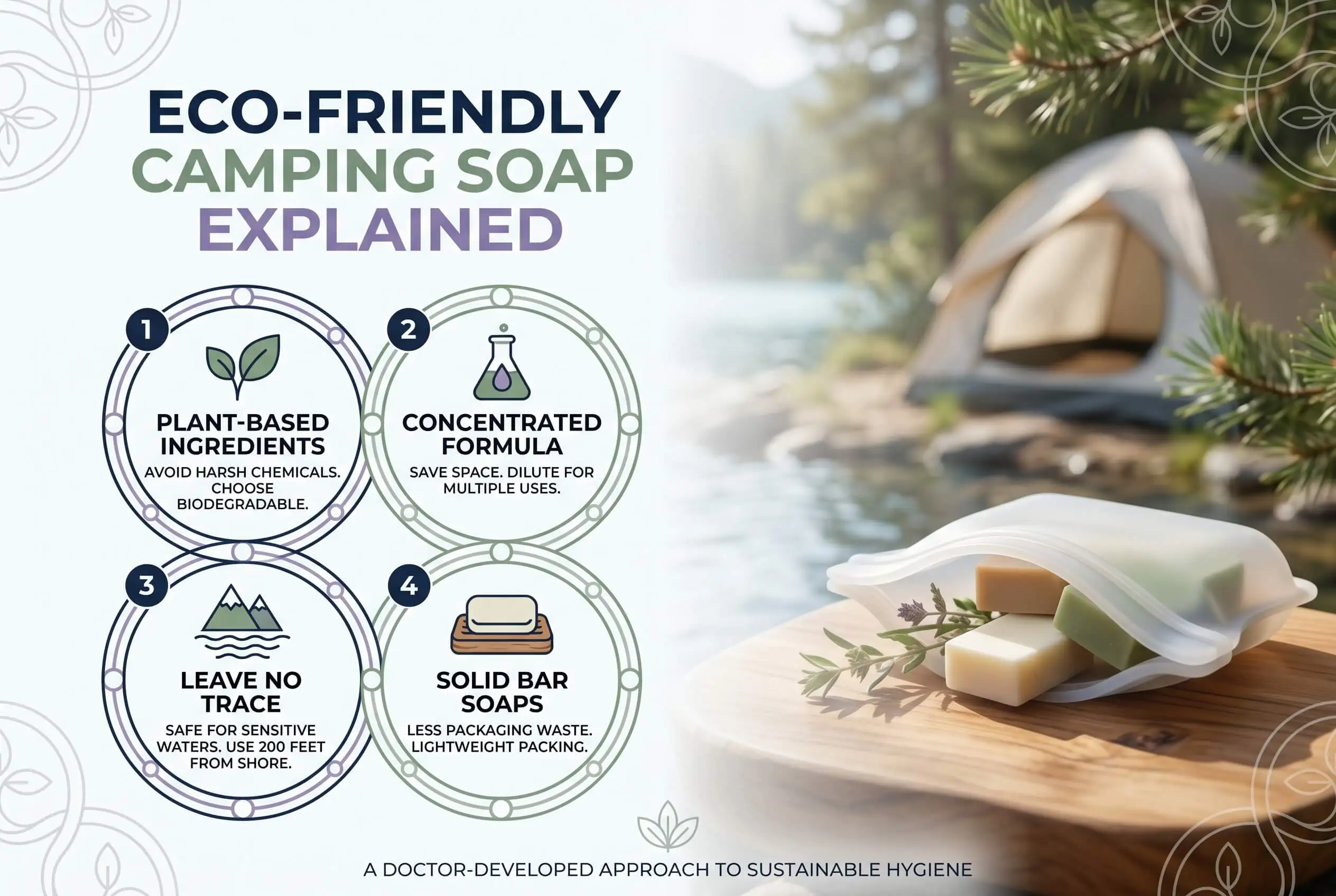
An eco-friendly camping soap has to get three things right. The ingredients have to come from plants, not petroleum. The rinse water has to break down in soil where microbes and oxygen can reach it. And the packaging has to stay out of a landfill.
Soap starts as a reaction between oils and an alkali. Wikipedia has a solid write-up on the general chemistry of soap if you want the full picture. Eco-friendly versions start with plant-derived oils like coconut, olive, hemp, or jojoba, and they skip the petroleum-based surfactants that cheap detergents rely on. They disclose their ingredient lists in full instead of hiding everything behind "fragrance." Their packaging is refillable, recyclable, or plant-based at minimum, never single-use plastic shipped across an ocean.
Here's the caveat. "Biodegradable" on the label means the soap will break down in soil, where microbes and oxygen do the work. Drop the same soap into a cold mountain stream and it persists far longer, still capable of harming aquatic life. The label describes how the compound breaks down, not where to put it.
Ingredients to Look For (and What to Avoid)
What to Look For
• Plant-derived surfactants, including sodium cocoate and other coconut-based cleansers that rinse clean and break down readily
• Organic essential oils used sparingly for scent: tea tree, peppermint, eucalyptus at low concentration
• Pure castile base: an olive-oil soap with a long track record in outdoor use
• Certified formulations: EPA Safer Choice, USDA Organic, NSF/ANSI 305, or Leaping Bunny
• Vegetable glycerin and other food-grade humectants
• Simple, short ingredient lists you can read without a chemistry dictionary
What to Avoid
• Phosphates, which drive algal blooms in freshwater
• Triclosan and other antibacterial additives, persistent in waterways and disruptive to aquatic life
• Sodium lauryl sulfate (SLS) and sodium laureth sulfate (SLES), aggressive surfactants that are harsh on skin and slow to break down
• Synthetic fragrances labeled only as "fragrance" or "parfum," usually a blend of undisclosed compounds that can include endocrine disruptors
• Parabens and PEG compounds
Microplastic exfoliants: any "microbead" language, or polyethylene and polypropylene listed as a scrubbing agent
• Non-certified palm oil, where sourcing is a problem the label won't disclose
Leave No Trace and the 200-Foot Rule
Even a genuinely biodegradable soap needs soil to do its job. The Leave No Trace Center for Outdoor Ethics sets the working standard: wash bodies, dishes, and clothes at least 200 feet from any lake, stream, or spring. That works out to about 70 adult paces. Bring water to your wash site in a jug or pot instead of bringing soap to the water.
Once you've used the soap, strain the greywater and scatter it in a wide arc across ground that can absorb it. Concentrated greywater in one spot creates a slick that wildlife will investigate and vegetation will struggle against. Wide dispersal lets soil microbes handle the rinse load.
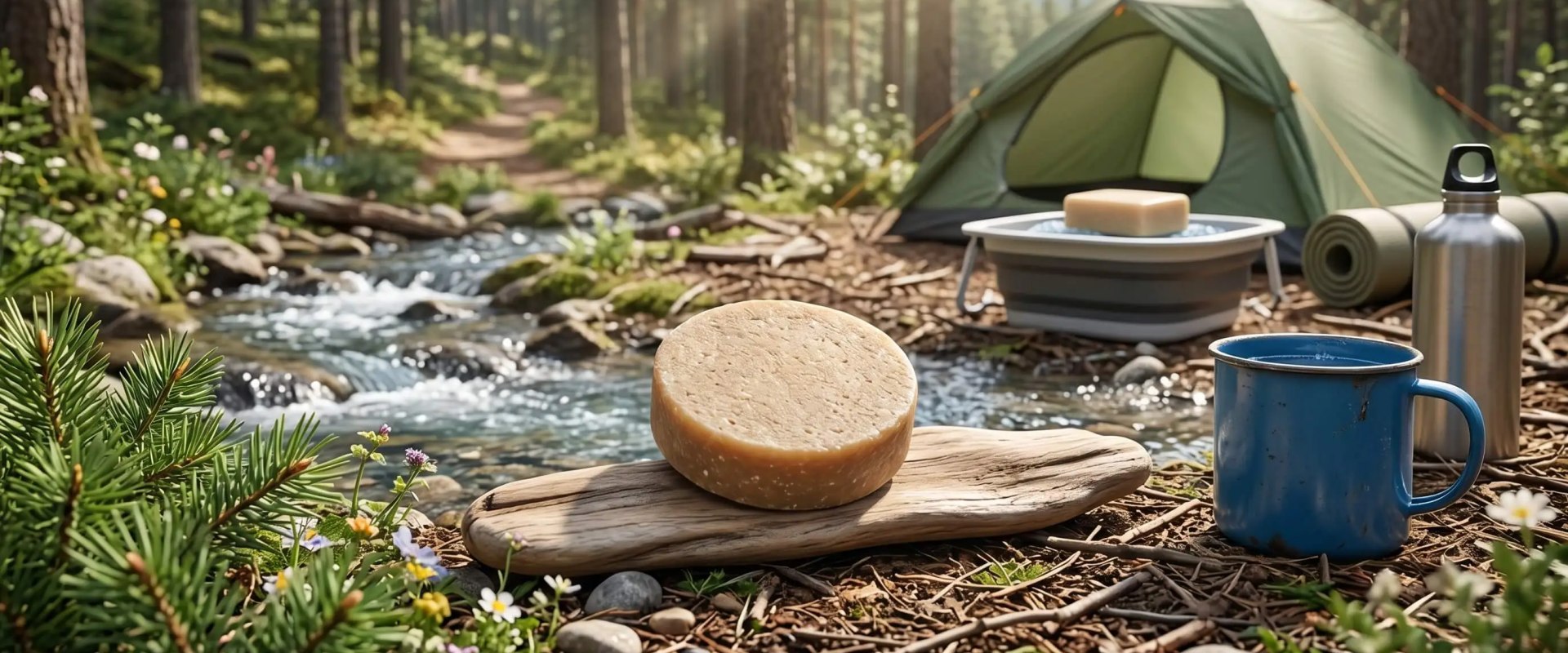
Pack a small collapsible basin. It keeps the soap-water contained during the wash, makes straining easy afterward, and stops suds from drifting back toward a stream you thought was a safe distance away, especially when camping near areas known for locally sourced produce and responsible land stewardship.
"I used to assume the 'biodegradable' label on my camp soap was doing most of the work. Then I watched a friend pour a rinse directly into a snowmelt stream and saw how long the foam lingered. Nothing breaks down quickly in cold water. These days I pack one concentrated castile that handles body, dishes, and a shirt in a pinch, carry a collapsible basin, and never wash within sight of water. The shift is smaller than people think, and the stream downstream of you looks exactly the way you found it."
7 Essential Resources
I've consulted each of these while picking products for trips, and I go back to them whenever a new brand appears on a shelf I can't read my way through.
• Leave No Trace Center for Outdoor Ethics, Dispose of Waste Properly: operational guidance on the 200-foot rule, greywater dispersal, and soap use in the backcountry. https://lnt.org/why/7-principles/dispose-of-waste-properly/
• National Park Service Leave No Trace Seven Principles: the framework applied across U.S. national parks, with current interpretations. https://www.nps.gov/articles/leave-no-trace-seven-principles.htm
• U.S. Forest Service No Trace Ethic: federal backcountry guidance that aligns with LNT and governs use on National Forest land. https://www.fs.usda.gov/lei/no-trace-ethics.php
• EPA Safer Choice: the federal certification that screens cleaning products for safer chemical profiles. Look for the label. Ingredients that make the cut are published on the EPA site. https://www.epa.gov/saferchoice
• EWG Skin Deep: a searchable database of more than 130,000 personal care products with hazard ratings on every ingredient. Useful as a sanity check on any camp soap you're considering. https://www.ewg.org/skindeep/
• USDA Agricultural Marketing Service, Cosmetics, Body Care, and Personal Care Products: the official explanation of what "USDA Organic" does and doesn't mean on a soap label, and which of the three organic tiers applies. https://www.ams.usda.gov/grades-standards/cosmetics-body-care-and-personal-care-products
• Leaping Bunny: the most rigorous cruelty-free certification I know of for personal care and cleaning products. Brands recommit every year and open their supply chain to independent audits. https://www.leapingbunny.org/
3 Statistics
• 181.1 million Americans aged six and older took part in outdoor recreation in 2024, which is 58.6 percent of the U.S. population in that age range. That's the participant pool buying camp soap at any given moment. Source: 2025 Outdoor Participation Trends Report, Outdoor Foundation and Outdoor Industry Association. https://oia.outdoorindustry.org/participation-trends-report-exec-summary
• More than 52 million North American households went camping in 2025, with camper spending driving a $66 billion economic footprint. Source: KOA 2026 Camping & Outdoor Hospitality Report. https://koa.com/north-american-camping-report/
• The U.S. organic personal care products market hit USD 6.31 billion in 2024 and is on track to reach USD 10.85 billion by 2030 at a 9.5 percent compound annual growth rate. Source: Grand View Research. https://www.grandviewresearch.com/industry-analysis/us-organic-personal-care-products-market-report
Final Thoughts and Opinion
Here's my working position. Concentration is the variable that matters most. A small bottle of concentrated castile will outperform a larger bottle of heavily watered product on every measure you care about: pack weight, cost per wash, and the greywater load left in the soil behind you.
Certifications help. EPA Safer Choice and USDA Organic both raise the floor. Neither of them replaces reading the ingredient list yourself.
I also think most buyers underweight the packaging question. A bottle that arrives in plastic headed for a landfill cancels a lot of what the formulation fixed. Refillable aluminum, concentrate sachets, and bar soap each solve for that in different ways. A cleanly formulated bar wrapped in paper is still the lowest-impact option I've found for backpacking trips that count ounces.
If you want a bottled option you can buy online and have shipped without hunting down a specialty store, you can find eco-friendly camping soap for sale online at Nowata Clean. Their formulation hits most of what's outlined above. I'm not going to pretend there's one right answer for every trip type. Car campers can carry heavier bottles. Thru-hikers live and die by the weight budget. Pick for the trip you actually take.
Frequently Asked Questions
Is biodegradable soap really biodegradable in the wild?
Biodegradable soap breaks down in soil, where microbes and oxygen do the work. In cold water, where both are scarce, it sticks around much longer and can still harm aquatic life. Biodegradability depends on the environment the soap lands in. That's why Leave No Trace asks you to move at least 200 feet from any water source before rinsing, regardless of what the bottle says.
How far from water should I wash with camping soap?
At least 200 feet, which works out to roughly 70 adult paces. That distance gives the soil enough filtering capacity to handle the greywater before it seeps toward streams, lakes, or springs. Bring wash water to your wash site in a pot or jug. Don't bring soap to the water. Strain after use and scatter the greywater across absorbent ground.
Can I use Dr. Bronner's as camping soap?
Yes, and plenty of backcountry users do. Pure castile bases are concentrated, multi-use, and ingredient-transparent. One caveat: even castile soap needs the 200-foot buffer from water. It's biodegradable under the right soil conditions. That doesn't make it stream-safe.
What ingredients should I avoid in camping soap?
The short list: phosphates, triclosan and other antibacterial additives, sodium lauryl sulfate (SLS) and sodium laureth sulfate (SLES), synthetic fragrance blends listed only as "fragrance," parabens, PEG compounds, microplastic exfoliants, and non-certified palm oil. Each one either harms aquatic life, sticks around in the environment longer than it should, or hides what's actually in the bottle.
Is scented camping soap a problem for wildlife?
It can be. Strong scents carry in the backcountry, and bears, rodents, and other wildlife will investigate any novel smell near a camp. A lightly scented soap with essential oils at low concentration is usually fine in non-bear countries. In active bear country, go unscented, and store the soap with your food in a bear canister or on a bear line.
Can the same soap be used for body, dishes, and clothes?
Yes. A good concentrated castile handles exactly that use pattern. One bottle covers washing, dishwashing, and spot laundry, which cuts your pack weight and your packaging load. Dilute more heavily for skin, more lightly for dishes, and use a dedicated wash site for each task so you're not mixing greywater loads near areas where farm produce is grown or handled.
Ready to Pack a Soap You Can Trust?
Stop guessing at labels. The Nowata Clean biodegradable soap for camping line meets the criteria on this page: concentrated, plant-based, ingredient-transparent, and shipped without the plastic excess. Have a look at the current options and pick the format that fits the way you actually camp, whether that's a bar, a bottle, or a concentrate.