An Excel recipe inventory template doesn't change what's on your shelves. It changes whether you see what's there before it spoils. That's the whole game with food waste reduction at the kitchen level. Visibility first, then action.
TL;DR Quick Answers
excel recipe inventory template
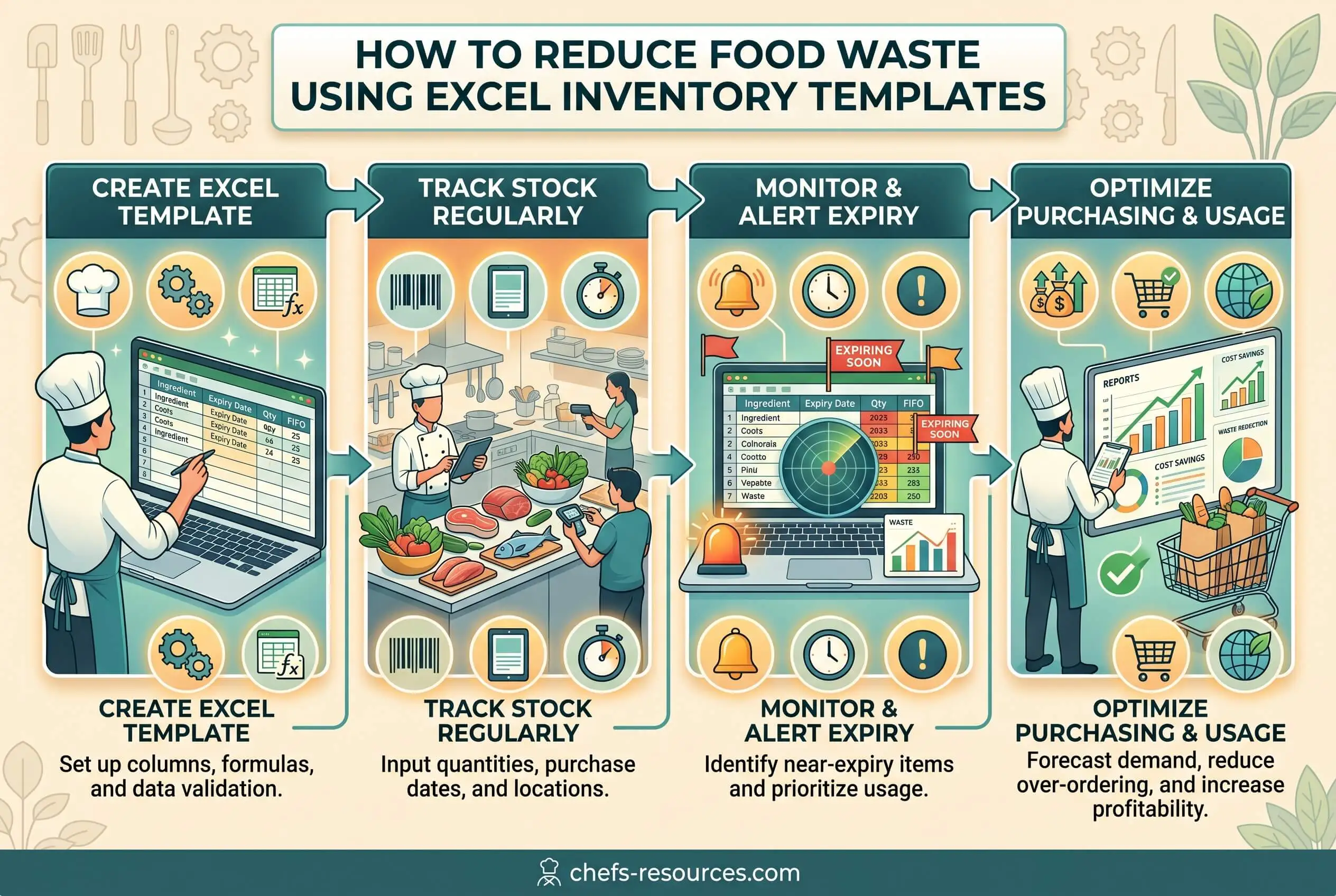
An Excel recipe inventory template is a spreadsheet workbook that links a master inventory tab to individual recipe tabs, so ingredient costs update automatically when prices change and waste patterns become visible across both shopping and prep.
What it includes at minimum:
Master inventory tab with item, category, unit, cost, quantity, total value, and PAR level
Recipe tabs (one per dish) with ingredients pulled from the master tab
Waste log tab capturing date, item, quantity, and reason for the toss
What it does in a working kitchen:
Calculates per-portion cost automatically when ingredient prices shift
Flags items sitting past their PAR window before they spoil
Surfaces over-ordering patterns across weeks of purchasing
Logs every toss so waste reasons accumulate into data, not memory
Basic food cost formula it supports: (Beginning Inventory + Purchases − Ending Inventory) ÷ Food Sales × 100
When it works best:
Home kitchens, single-location cafes, catering operations, and culinary classrooms
Operations running under roughly 200 SKUs
Teams already comfortable in Excel or Google Sheets
Our take: A free Excel recipe inventory template opened every Sunday outperforms paid software opened twice a quarter. The file isn't the lever. The habit of opening it is.
Top Takeaways
If you're skimming, these are the points worth holding on to.
Visibility beats willpower. You can't reduce what you don't measure, and a spreadsheet measures faster than memory.
Excel is enough for most operations. Disciplined spreadsheet use outperforms sophisticated software nobody opens.
Your recipes shape your inventory. The structure of any recipe dictates which ingredients you need and how often, which is why linked recipe tabs are the most valuable part of a working template.
PAR levels stop over-buying. Set them once based on real usage, then revisit quarterly as menus and seasons shift.
Tracking pays back fast. Industry data shows roughly $7 saved for every $1 invested in food waste reduction programs.
Why a Spreadsheet Still Beats Most Software for Smaller Kitchens
Software wins on features. Spreadsheets win on adoption. We've watched plenty of home cooks abandon beautifully designed pantry apps inside a week. We've also watched small cafe owners run tight food cost numbers on a single Excel file for years.
The reason isn't technical. It's behavioral. Excel opens fast, runs offline, and doesn't ask for a login every time you want to update one number. For Excel recipe inventory tracking at home or small-business scale, that low friction is the whole game, especially when a quick plate cost calculation depends on keeping ingredient prices current. The system that doesn't get opened doesn't work, no matter how sophisticated it looked at signup.
What an Excel Recipe Inventory Template Should Actually Contain
A working template doesn't need to be elaborate. It needs to surface the right information without making you fight the file. At minimum, three connected tabs do the job.
Master Inventory Tab
This is the single source of truth for what's in the kitchen and what it costs. Include:
Item name and category (produce, protein, dairy, dry goods)
Unit of measure (each, ounce, pound, gram, cup)
Unit cost
Quantity on hand
Total value, calculated by a simple multiplication formula
PAR level, the minimum quantity you want on hand before reordering
Reorder point and expected use-by window
Recipe Tabs
One tab per recipe, each linked back to the master inventory so ingredient costs update automatically when prices change. If you bake or batch cook, this is where the real value shows up. A small price shift on butter ripples through every cookie recipe you've cost, without you touching another number.
For a deeper walkthrough on how to cost out home recipes, our free recipe costing template for home chefs guide covers the per-portion math step by step.
Waste Log Tab
This is the tab nearly everyone skips. It's also the one that changes behavior. Each entry is small: date, item, quantity tossed, one-word reason (spoiled, overprepped, plate waste, expired). After two weeks of honest logging, patterns show up that no amount of guesswork would have caught.
How the Template Cuts Food Waste in Practice
A spreadsheet on its own doesn't cut waste. What it does is make waste visible enough that you can act on it.
Slow movers surface. When an item has been sitting past its PAR window, the spreadsheet shows it. You cook with it instead of around it. We've watched home cooks log cilantro on the waste sheet three Sundays in a row before they realized the fix was halving the buy, not exercising more restraint.
Over-ordering becomes visible. Comparing weekly purchases against actual usage reveals patterns that don't show up day to day. Three pounds of cilantro every Tuesday and one pound left every Sunday is a $4 weekly leak. It only becomes obvious in retrospect, and only if someone wrote it down.
Recipe-linked costing catches oversized prep batches. A pot of sauce that's gorgeous on Wednesday but tired on Saturday shows up as a real dollar figure when the recipe tab is doing its job. The number is more persuasive than the smell.
For operators running a daily kitchen routine, pairing the template with a structured pass like our daily kitchen management checklist for restaurant managers gives the data somewhere to land.
Setting Yours Up in One Sitting
You don't need a weekend. You need about ninety minutes and a willingness to start small.
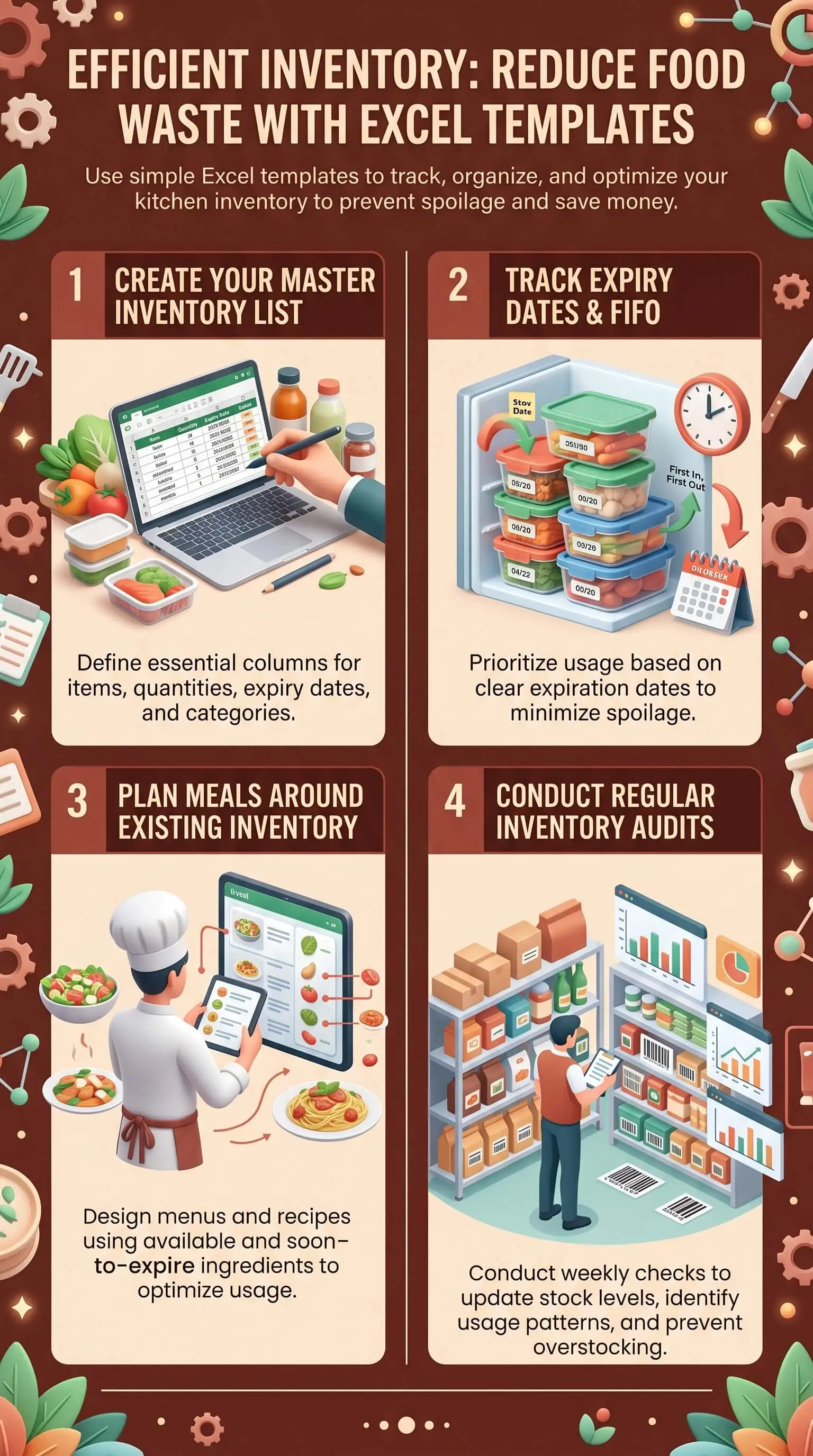
Download a starter template, or build a simple one-tab inventory list.
Enter your top twenty most-purchased items with units, costs, and current quantities.
Set rough PAR levels based on one week of typical usage.
Add a waste log tab and commit to logging every toss for two weeks. Honesty beats accuracy.
Review every Sunday. Adjust the next grocery order or supplier sheet based on what the data shows.
We've watched kitchens running sophisticated software hold a 38% food cost because nobody opens the reports. We've watched operations using a basic Excel file hold steady at 28% because someone reviews the numbers every morning before placing orders. The template you'll actually open beats the platform you'll abandon. Five minutes on a Sunday afternoon is what separates the two.
“We've watched kitchens running sophisticated software hold a 38% food cost because nobody opens the reports. We've watched operations using a basic Excel file hold steady at 28% because someone reviews the numbers every morning before placing orders. The template you'll actually open beats the platform you'll abandon. Five minutes on a Sunday afternoon is what separates the two.”
7 Essential Resources
These are the sources we keep coming back to when we're refining our own approach or recommending one to someone else. Government data, industry research, and free downloadable tools, mixed together so you can build a system without paying for one.
1. USDA Food Loss and Waste Overview
The U.S. Department of Agriculture's central hub for national food waste data, definitions, and reduction programs. Useful for sizing the problem before you start measuring your own slice of it. https://www.usda.gov/about-food/food-safety/food-loss-and-waste
2. EPA Wasted Food Scale
The EPA's updated framework for managing wasted food, from prevention down through disposal. The hierarchy alone reframes how you'll think about leftover prep. https://www.epa.gov/sustainable-management-food/wasted-food-scale
3. Champions 12.3 — The Business Case for Reducing Food Loss and Waste: Restaurants
A study of 114 restaurants across 12 countries documenting the financial return of food waste reduction programs. The headline number, $7 saved for every $1 invested, is the most-cited stat for a reason. https://champions123.org/publication/business-case-reducing-food-loss-and-waste-restaurants
4. Smartsheet Free Food Inventory Templates
A solid collection of free downloadable templates for restaurant inventory, pantry tracking, waste logging, and expiration monitoring. Available in Excel and Google Sheets. Good starting point if you don't want to build from a blank file. https://www.smartsheet.com/content/food-inventory-templates
5. ReFED Insights Engine
The most thorough U.S. food waste analysis tool we've found, including a Solutions Database that ranks reduction strategies by cost, environmental impact, and feasibility. Best for anyone working on a longer-term plan. https://insights.refed.org/
6. FAO Food Loss and Waste Database
The Food and Agriculture Organization of the United Nations maintains the largest open collection of food loss and waste data globally. Useful for benchmarking and for the bigger-picture context behind kitchen-level numbers. https://www.fao.org/platform-food-loss-waste/flw-data/en
7. National Restaurant Association — Working to Reduce Food Waste
Industry association guidance focused on demand forecasting, staff training, and standard operating procedures for waste reduction in foodservice settings. Practical for anything larger than a home kitchen. https://restaurant.org/education-and-resources/resource-library/working-to-reduce-food-waste/
3 Statistics
Numbers matter here because they make the abstract concrete. Each figure below comes from a primary source you can verify yourself.
1. The U.S. wastes 30 to 40 percent of its food supply
The USDA estimates food waste at 30 to 40 percent of the U.S. food supply, which corresponded to roughly 133 billion pounds and $161 billion worth of food at the 2010 baseline. That's the gap between what's produced and what actually nourishes someone. Source: USDA Food Loss and Waste
2. Restaurants save $7 for every $1 invested in waste reduction
Champions 12.3, in a study of 114 restaurants across 12 countries, found that on average operators saved $7 in operating costs for every $1 spent on food waste reduction programs. Within one year, restaurants in the study had cut kitchen waste by 26 percent on average. Source: Champions 12.3, The Business Case for Reducing Food Loss and Waste: Restaurants
3. Food is the single largest material in U.S. landfills
EPA data shows that food makes up roughly 24 percent of municipal solid waste landfilled in the United States, more than any other material category. In 2019, 66 million tons of wasted food were generated by food retail, food service, and residential sectors combined, with about 60 percent sent to landfills. Source: EPA Food: Material-Specific Data
Final Thoughts and Opinion
We've built inventory systems that worked and inventory systems that quietly died. The pattern is consistent. Tools matter less than the commitment to use them.
A spreadsheet doesn't change your values. It hands you a mirror. The numbers you put into it tell you, without spin, how much of what you bought actually became food someone ate. That's where sustainability stops being abstract and becomes a Sunday afternoon decision.
Our honest take: the spreadsheet isn't the solution. The five minutes you spend with it every week is.
Frequently Asked Questions
What is an Excel recipe inventory template and how does it reduce food waste?
An Excel recipe inventory template is a spreadsheet that connects your ingredient stock to the recipes you actually make, so the same numbers feed both costing and waste tracking. It reduces food waste by surfacing slow-moving items, flagging items approaching expiration, and revealing patterns of over-ordering you can't easily catch in real time. The reduction comes from acting on what the data shows, not from the template itself.
Can I use a free Excel template, or do I need to pay for one?
A free template works for most home and small-business cases. Smartsheet, Apicbase, and several other publishers offer free downloads in both Excel and Google Sheets. Paid templates and software become worth considering once your operation crosses about 200 distinct SKUs, runs multiple locations, or needs real-time POS integration. Below that scale, a free file used consistently will outperform a paid system used inconsistently.
How often should I update my recipe inventory spreadsheet?
For home kitchens, a weekly Sunday review is usually enough. For small foodservice operations, daily counts on high-cost or theft-prone items paired with a full weekly inventory is the standard rhythm. The schedule that matters is the one you can sustain for six months. Inconsistent daily counts tell you less than reliable weekly ones.
What columns should every inventory template include?
At minimum: item name, category, unit of measure, quantity on hand, unit cost, and total value. For better functionality, add PAR level, reorder point, expiration date, and a waste log tab. Organize tabs by storage location, such as pantry, fridge, freezer, and dry goods, rather than alphabetically. The template should match how you physically move through the space when counting.
Will this work for a home kitchen, or only for restaurants?
Both, with small adjustments. Home kitchens benefit most from the waste log and PAR-level features, which curb the impulse over-buying that drives household food waste. Restaurants add layers like ideal versus actual food cost tracking and supplier price variance. The underlying structure is the same. Scale the columns to match the operation.
Start Cutting Waste This Week
You don't need a system overhaul. You need one tab, twenty items, and one quiet Sunday. Pick a template, fill in what's already on your shelves, and start a waste log you'll actually keep, especially for locally sourced produce you want to use at peak freshness. The savings won't feel dramatic in week one. By week six, you'll wonder how you ever shopped without it.